


A coolify vps should have enough memory for Coolify, Docker images, builds, databases, and your running apps—not just enough to pass the installer check. For most small production stacks, the Buffalo Linux VPS 4 GB is the practical starting point at $9.99/mo; choose 2 GB for a lighter test stack or 8 GB when you expect several services.
What Coolify does on a VPS
Coolify is a self-hosted deployment platform. You connect a Git repository or container image, and Coolify manages the application containers, reverse proxy, domains, deployments, databases, and other services on your own Linux server. It gives you a control-panel workflow without moving every application to a separate hosted platform.
That also means your VPS runs more than your application. The server must reserve memory for Coolify’s own services, Docker, image layers, build processes, logs, volumes, and any database you deploy alongside the app. This is why a plan that technically starts Coolify can still feel cramped once you deploy real projects.
The official Coolify self-hosted requirements list 2 CPU cores, 2 GB RAM, 10 GB of free disk, and amd64 or arm64 architecture. The same documentation says to increase resources as your workload grows. Its installation troubleshooting guidance also recommends at least 30 GB of total disk and 20 GB available when Docker images and application data are involved.
Official minimum vs practical sizing
The 2 GB requirement is a starting line, not a complete production recommendation. It describes what Coolify needs to run; it does not reserve a comfortable margin for builds, a database, or several containers.
Use this simple rule when choosing a plan:
| Workload | Sensible size | Why |
|---|---|---|
| Dashboard test, one small static or API app | 2 GB RAM, 2 vCPU | Meets the documented minimum with room for a small first deployment |
| Several small apps, one database, or regular builds | 4 GB RAM, 3 vCPU | Leaves usable memory after Coolify and Docker are running |
| Several applications, databases, workers, or heavier builds | 8 GB RAM, 4 vCPU | Gives containers and build jobs more headroom |
| Large multi-service system or busy databases | 16 GB or more | Lets you separate workloads and plan for growth |
Disk matters almost as much as RAM. A 10 GB free-space requirement can disappear quickly after you pull multiple images, create persistent volumes, retain logs, and build new releases. For a new Coolify server, 40 GB is a more comfortable floor and 60–100 GB is easier to manage when you host more than one application.
Buffalo VPS plans that fit Coolify
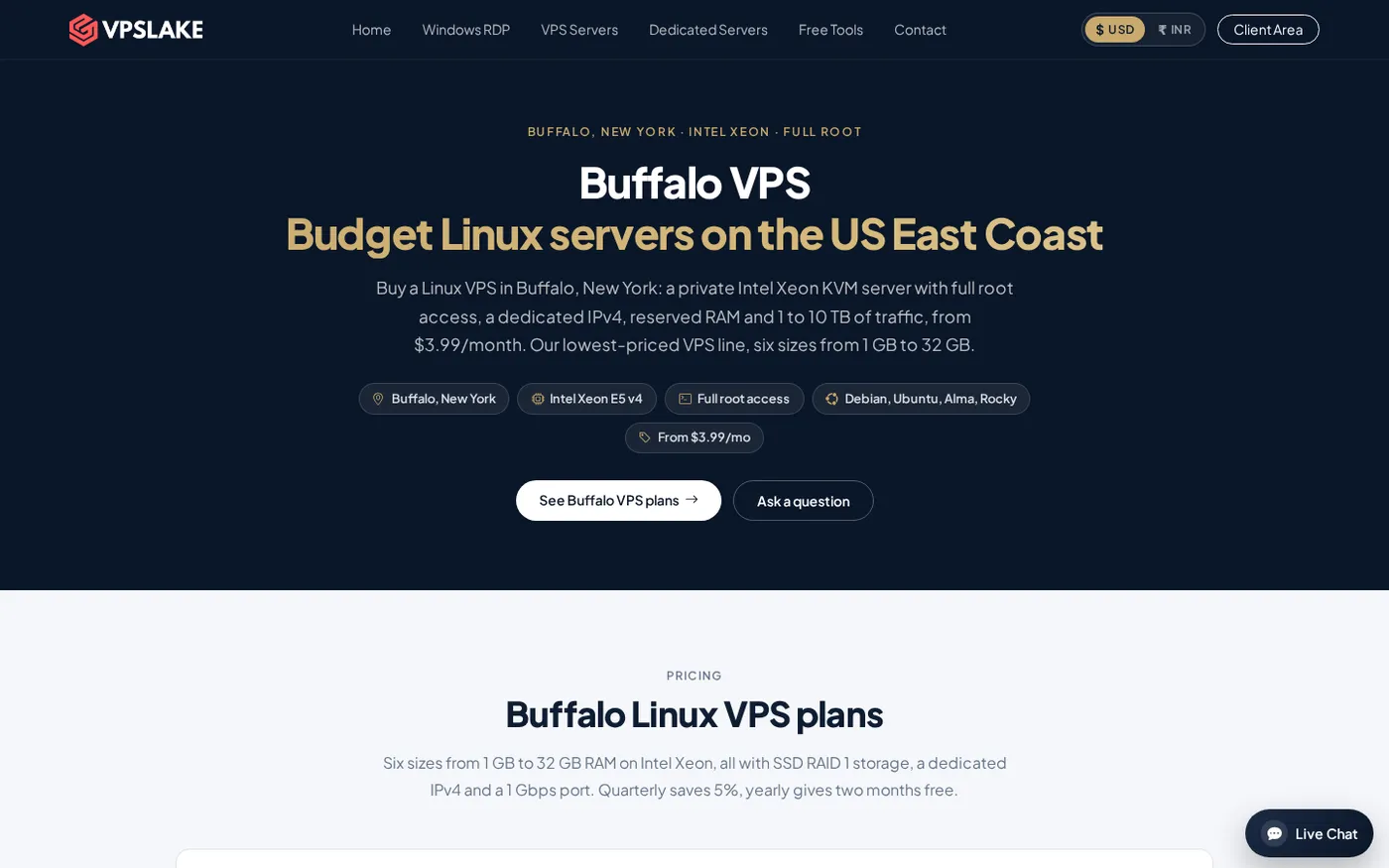
VPSLake’s Buffalo Linux range uses private KVM virtual machines, reserved RAM, full root access, one dedicated IPv4 address, and SSD RAID 1 storage. The operating-system choices include Debian 12, Ubuntu 24.04, AlmaLinux 9, and Rocky Linux 9, all suitable starting points for a Coolify host.
| Plan | Resources | Storage and traffic | Monthly price | Best use |
|---|---|---|---|---|
| Buffalo Linux VPS 2 GB | 2 vCPU, 2 GB RAM | 40 GB SSD, 2 TB traffic, 200 Mbps port | $5.99/mo | First Coolify server with one or two light apps |
| Buffalo Linux VPS 4 GB | 3 vCPU, 4 GB RAM | 60 GB SSD, 3 TB traffic, 200 Mbps port | $9.99/mo | Best balance for apps, builds, and one database |
| Buffalo Linux VPS 8 GB | 4 vCPU, 8 GB RAM | 100 GB SSD, 5 TB traffic, 300 Mbps port | $16.99/mo | Several apps, databases, workers, or heavier builds |
| Buffalo Linux VPS 16 GB | 6 vCPU, 16 GB RAM | 200 GB SSD, 8 TB traffic, 500 Mbps port | $29.99/mo | Larger multi-service workloads |
The 4 GB plan is the best default because it clears the official minimum by a useful margin. You get storage for images and volumes, three vCPUs for builds and application work, and a dedicated US IPv4 address for DNS and reverse-proxy traffic.
How many apps fit on 2 GB, 4 GB, and 8 GB?
There is no fixed app count because a static site, a Node build, a queue worker, and a database have very different resource profiles. Treat the following as planning ranges rather than a capacity guarantee.
2 GB: a lean starting point
Choose 2 GB when you are learning Coolify, deploying one small application, or running a low-traffic personal project. It has the 2 vCPU baseline and 40 GB of storage.
Keep the stack simple. One lightweight app and a small supporting service can fit, but simultaneous builds, a database, and background workers will reduce your margin. If you expect regular deployments or want to keep multiple images and volumes, the 4 GB plan is the safer purchase.
4 GB: the practical default
The 4 GB plan suits a small SaaS, API plus frontend, several brochure sites, a personal project collection, or an application with one modest PostgreSQL or MySQL database. It also gives Docker builds more breathing room than the 2 GB tier.
Choose this plan when you want one VPS to host Coolify and several related services. Its 60 GB SSD allocation gives you room for multiple images and application volumes.
8 GB: more services and less resource pressure
Move to 8 GB when you are running several applications, a database plus cache, background workers, scheduled jobs, or builds that use more memory. It is also a better fit for a small team that deploys frequently and does not want every build to compete with live containers.
If your workload has genuinely high traffic, large databases, or strict availability requirements, plan for backups and a larger architecture rather than assuming one larger VPS solves every problem. Coolify can help manage deployments, but it does not remove the need to size and operate the underlying server responsibly.
For more general sizing context, see our guide to how much RAM a VPS needs for Docker and the best VPS options for n8n.
Coolify VPS vs hosted PaaS cost
Self-hosting changes the cost model. With Coolify, you pay for the VPS and manage the operating system, updates, backups, domains, and application data. The Coolify control plane is not a separate per-app platform bill, so the same server can host multiple small applications within its available resources.
That makes the $9.99/mo 4 GB plan attractive for a small collection of apps. A hosted PaaS can be simpler for a single project because the provider handles more infrastructure, but the bill is usually organized around separate project, compute, database, build, or bandwidth usage. Check Heroku’s official pricing and Vercel’s Hobby documentation for their current terms; their tiers are not the same as a general-purpose server for databases and long-running services.
The fair comparison is not “VPS price versus a free tier.” Compare runtime, databases, background jobs, build time, storage, backups, and whether you need a dedicated IP. If Coolify will host several small services, one fixed VPS bill can be easier to forecast. If you only need a personal frontend and do not want server administration, a hosted platform may be more convenient.
What to check before ordering
Choose the plan from the workload, then verify these details before you pay:
- CPU: Start with at least two cores. Builds and multiple containers benefit from additional vCPUs.
- RAM: Count Coolify, Docker, app processes, databases, workers, and build peaks—not just idle usage.
- Disk: Leave room for images, volumes, logs, and backups. The plan’s advertised disk is not all disposable build space.
- Operating system: Use a supported 64-bit Linux distribution. Ubuntu 24.04, Debian 12, AlmaLinux 9, and Rocky Linux 9 are available on the Buffalo plans.
- Network and IP: Coolify normally needs a public address for DNS and web traffic. A dedicated IPv4 simplifies setup.
- Access: You need SSH and root or sudo access to install and administer the server.
- Payments and renewal: VPSLake accepts crypto, UPI, and cards. Quarterly billing saves 5%, while yearly billing gives two months free.
The Buffalo Linux VPS page shows the current plan table and order options. The 4 GB plan includes full root access and KVM virtualization, so you control the server environment Coolify runs on.
Backups, updates, and security
Treat Coolify as a deployment control plane, not as a backup destination. Back up application data and database exports to storage separate from the VPS. Keep copies of environment variables and deployment secrets, and test that you can restore a database before you need it.
The Coolify documentation specifically calls out /data/coolify/source/.env as an installation secret file to protect for recovery. Create the first administrator account immediately, restrict dashboard and SSH access, and apply updates on a schedule.
You should also review firewall rules before exposing services. VPSLake’s UFW firewall generator can help produce a starting ruleset, but check every generated rule against the ports your applications actually require.
FAQ
What is the minimum VPS size for Coolify?
Coolify’s current self-hosted documentation lists 2 CPU cores, 2 GB RAM, and 10 GB of free disk as the minimum. That is suitable for a small first deployment, but 4 GB RAM and at least 40 GB storage gives a more useful margin for Docker images, builds, and a database.
Is 1 GB RAM enough for Coolify?
It is below Coolify’s documented 2 GB RAM and 2-core minimum, so it is not a sensible new-server target. Use the 2 GB tier for a lean test or the 4 GB tier for a server you expect to keep using.
Is 4 GB RAM enough for Coolify and Docker?
Yes, 4 GB is a practical starting size for Coolify, several small containers, and one modest database when the applications are sized sensibly. Leave additional room if you run memory-heavy builds, queues, caches, or multiple databases.
Can Coolify replace Vercel or Heroku?
Coolify can provide a self-hosted deployment workflow for many Docker-compatible applications, but it does not remove server administration. It is a strong fit when you want control over a VPS and several services; a hosted PaaS may be simpler for one small project.
Which VPS is best for Coolify?
For most small production stacks, the Buffalo Linux VPS 4 GB is the best balance: 3 vCPU, 4 GB reserved RAM, 60 GB SSD storage, a dedicated IPv4 address, and $9.99/mo pricing. Choose 2 GB for a light test stack and 8 GB when you need more containers, databases, workers, or build headroom.