


A no kyc vps is a virtual private server you can order without uploading government ID for a standard purchase, usually with cryptocurrency as the payment method. It reduces the amount of identity information shared during signup, but it does not make you invisible, remove abuse rules, or turn a server into a place where anything is allowed.
What KYC means for hosting
KYC means “Know Your Customer”. In practice, it is an identity-check process in which a service asks for information such as your legal name, address, phone number, or a government document before approving an account or transaction.
For hosting, the phrase is used less consistently than it is for banks and crypto exchanges. A provider may call an order “no KYC” when it does not ask for a passport, driving licence, selfie, or video check. It may still ask for a working email address, account password, contact details, or payment information.
That distinction matters because “no KYC” usually describes one point in the signup flow: no routine documentary identity verification. It does not describe every record a host or payment processor can hold, and it does not promise that a provider will never ask questions about an unusual payment or order.
The Financial Action Task Force (FATF) treats virtual assets as a payment technology with both benefits and risks, and says virtual-asset providers may need customer due diligence, record keeping, and suspicious-transaction reporting under applicable rules. You can read its overview of virtual assets and the controls around them before choosing a crypto-based service.
What a no-KYC VPS gives you — and what it doesn’t
The useful benefit is less friction and less routine collection of identity documents. That can help a privacy-conscious developer or a customer whose card is not accepted for an international hosting purchase.
Here is the cleanest way to separate the promise from the marketing:
| A no-KYC VPS may give you | It does not automatically give you |
|---|---|
| No passport, licence, or selfie upload for a standard order | Legal anonymity or immunity from a lawful investigation |
| A way to pay without putting a hosting charge on a bank card | An untraceable payment trail |
| A VPS account opened with limited signup information | A no-logs guarantee |
| Your own virtual machine, IP address, and administrator or root access | Permission to run malware, spam, attacks, fraud, or copyright abuse |
| Faster automated provisioning after payment confirmation | A guarantee that every future order will avoid additional verification |
The server itself is still connected to a network. The provider can generally see operational data needed to deliver and protect the service, such as the account, IP address, timestamps, resource use, and abuse reports. The exact data collected and retained depends on the provider’s privacy notice and systems, so do not treat a no-KYC label as a substitute for reading those policies.
Privacy is not permission: abuse rules still apply
A VPS is infrastructure, not a legal safe zone. You remain responsible for the software you install, the traffic your server sends, the content you host, and the rules that apply to you.
That includes ordinary projects such as a website, API, VPN for your own devices, Docker services, a development box, or a monitoring tool. Secure the server so it does not become a platform for someone else’s activity.
Hosts can act on malware, phishing, port scanning, credential theft, unsolicited bulk mail, copyright complaints, attacks against other networks, and other abuse. A no-KYC purchase does not suspend acceptable-use rules. A host may investigate a serious complaint or lawful request, restrict a service, request more information, or preserve relevant records under its policies and applicable law.
This is also why “bulletproof VPS” is a warning sign rather than a feature to seek. A provider that promises to ignore abuse reports may put your IP reputation, applications, and data at risk. A privacy-focused host should explain what information it requests, how payments work, and how it handles abuse without promising that rules do not exist.
Paying with crypto: USDT, BTC and the trade-offs
Crypto can remove a bank card or bank account from the hosting checkout when an international card is declined or you prefer not to put the merchant on a card statement. The payment is still a transaction, and the network, wallet, exchange, or processor may create records.
Bitcoin is pseudonymous, not automatically anonymous. Bitcoin’s own documentation explains that transactions are recorded publicly and permanently and that an address can sometimes be connected to a person depending on how it is used. Read Bitcoin’s explanation of privacy and identity before assuming that BTC hides the payer.
USDT can make the invoice easier to budget because it is designed to track the US dollar, but the token exists on multiple networks. Send only the asset and network shown on the provider’s invoice. A payment sent on the wrong network, to the wrong address, or for the wrong amount may not be recoverable.
The usual flow is simple:
- Select a VPS size, operating system, billing cycle, and location.
- Create the hosting account with the information the order form requests.
- Choose the crypto payment option and confirm the invoice’s coin, network, amount, and expiry time.
- Pay from your wallet and wait for the required network confirmation.
- Keep the invoice and transaction ID with your order records.
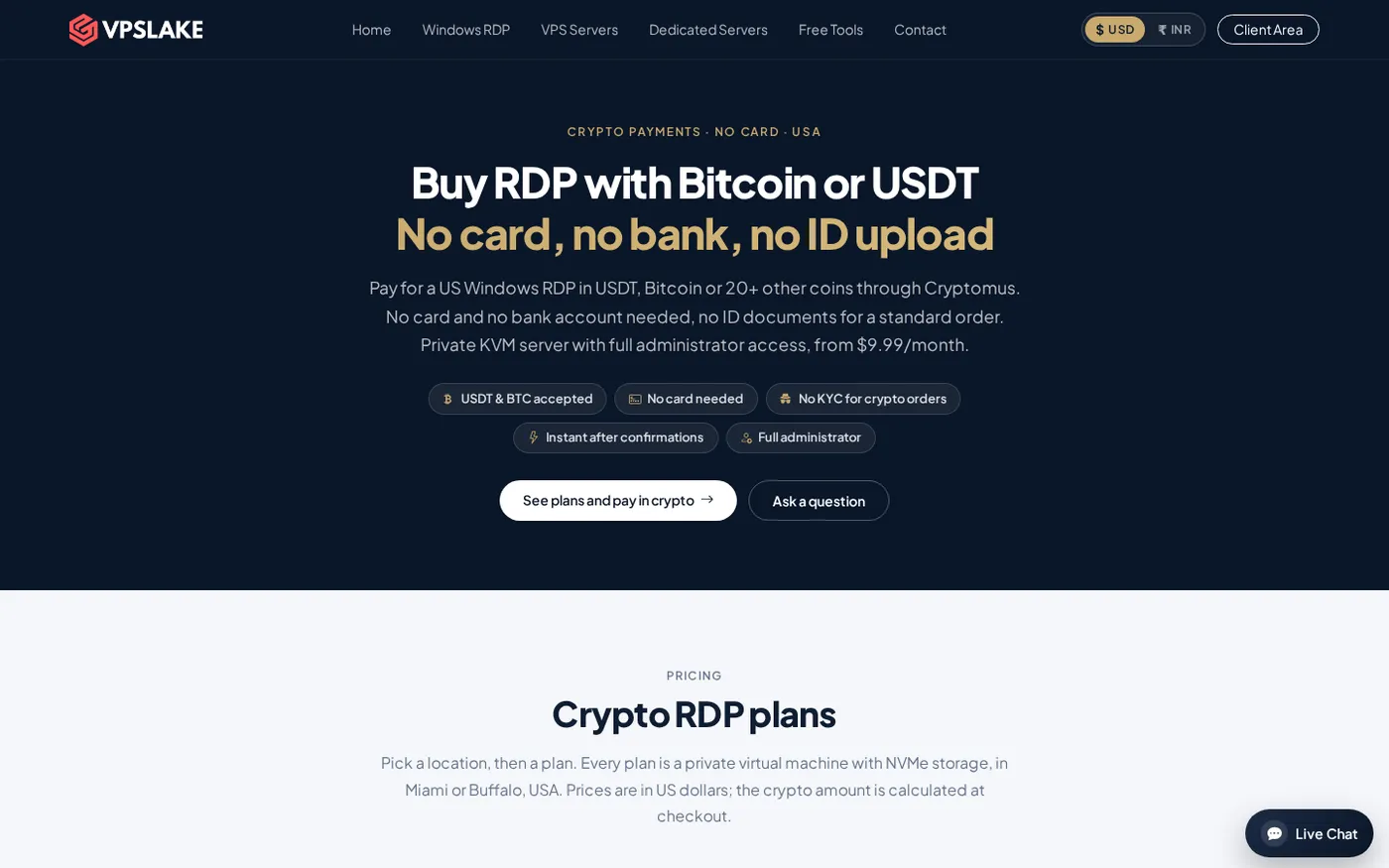
For a practical walkthrough of the payment rail, see how to buy a VPS with USDT. If you want to use crypto specifically for remote Windows access, VPSLake also explains how to buy RDP with crypto.
What VPSLake asks at signup
VPSLake’s standard crypto order is designed for customers who do not want to upload identity documents. The crypto checkout uses a working email address and the order-form fields needed to create and deliver the service; a standard order does not require a passport, licence, or selfie upload.
The privacy benefit is specific: you can order a server without routine document KYC and pay with crypto. It is not a claim that VPSLake cannot associate an account with an email, payment, IP address, support conversation, or server activity. Keep your account email secure because provisioning and account information are delivered there.
For a low-cost Linux server, the in-stock Buffalo line starts at $3.99/mo for 1 GB and the 2 GB plan is $5.99/mo. The 2 GB Buffalo Linux VPS includes 2 vCPUs, 40 GB SSD storage, 2 TB traffic, a dedicated IPv4, full root access, and KVM virtualization. Buffalo is the currently available VPSLake location for this line; check the order page for live availability before paying.
How to choose a privacy-focused VPS
Compare the privacy process and the actual server, not just an “anonymous” badge:
- Define the data you want to avoid sharing. Is your concern a passport upload, card details, a public business address, or all of them? Different payment methods solve different parts of that problem.
- Read the signup and privacy pages. Look for the required email, payment processor, support records, IP information, retention language, and circumstances that can trigger additional review.
- Confirm the payment network. A crypto invoice is only useful if your wallet supports the exact coin and network. Check the amount and destination every time.
- Check the machine’s isolation and access. For Linux, look for KVM, reserved RAM, full root access, a dedicated IPv4, and a clear traffic allowance. For Windows, check whether the licence is included or BYOL.
- Check the abuse policy. A clear policy is healthier than a promise to ignore complaints. You want privacy for legitimate work and a provider that protects the network around your server.
- Match resources to the workload. A 2 GB server can suit a small bot, a test box, or a lightweight service. Docker stacks, databases, and several simultaneous applications may need 4 GB or 8 GB.
VPSLake’s Buffalo Linux VPS plans fit the privacy-focused use case when you want a small KVM machine with full root access, reserved RAM, a dedicated US IPv4, and crypto, UPI, or card payment options. If you need Windows instead, remember that VPSLake’s Windows images use BYOL: you bring the Windows licence, and the image is supplied without a licence surcharge.
Privacy habits for your own server
The provider’s signup process is only one layer. Once the VPS is online, protect the machine and your account:
- Use a unique, long account password and enable multi-factor authentication wherever the provider offers it.
- Add SSH keys for Linux and disable password login after confirming the key works.
- Allow only the ports your application needs and keep the operating system and packages updated.
- Store secrets in environment variables or a secret manager rather than in public repositories or shell history.
- Keep backups that you control, and test restoring one before you need it.
- Monitor login attempts, outbound traffic, disk usage, and unexpected processes.
These steps protect your server from compromise; they do not make the server anonymous. They also reduce the chance that a legitimate privacy goal turns into an avoidable security incident.
FAQ
Is a no KYC VPS legal?
A no KYC VPS is a hosting signup model, not a legal category. Whether your use of the server, cryptocurrency, and hosted content is lawful depends on your location, activity, and the provider’s terms, so use it only for legitimate work and check the rules that apply to you.
Can I buy a VPS without uploading ID?
Some providers allow a standard order without a passport, licence, or selfie, especially when you pay with cryptocurrency. You may still need an email address, order details, and a payment transaction, and a provider can have additional checks for unusual orders or support situations.
Is crypto VPS hosting anonymous?
No. Crypto can reduce the personal information shared at checkout, but blockchain transactions, wallet records, exchange records, email, IP data, and server activity can sometimes be linked. Treat crypto as a privacy tool with limits, not as an anonymity guarantee.
What is the cheapest privacy-focused VPS at VPSLake?
The Buffalo Linux VPS 1 GB plan is $3.99/mo, and the 2 GB plan is $5.99/mo. Both include KVM virtualization, full root access, a dedicated IPv4, and a defined traffic allowance; choose the size based on your workload rather than price alone.
Does no KYC VPS mean the provider keeps no logs?
No. “No KYC” normally describes document verification at signup. It does not prove that a provider keeps no operational, account, payment, support, or abuse-related records; check the provider’s privacy and acceptable-use terms.