


RackNerd alternatives make sense when you want a predictable monthly VPS, a Buffalo location, or payment options beyond the usual card checkout. Our top pick is VPSLake’s Buffalo Linux VPS because it combines low monthly pricing with reserved RAM, KVM virtualization, a dedicated IPv4 address, and full root access without requiring you to wait for a yearly promo.
Why RackNerd buyers look elsewhere
RackNerd is popular for low-cost KVM VPS specials, especially when you are happy to pay for a year upfront. Its current public offers cover small Linux servers, multiple locations, root access, SSD storage, an IPv4 address, and a control panel.
That model is not ideal for every buyer. You may prefer month-to-month billing while you validate a project, UPI or crypto payments, or a provider that clearly states reserved memory and the included IPv4. You may also want a Windows desktop later.
VPSLake fits that buyer with Buffalo, New York Linux VPS plans from $3.99/mo. The 2 GB plan is the practical starting point for a small site, bot, API, Docker stack, or automation service; the 4 GB and 8 GB sizes give you room to grow.
What matters in a budget VPS
The lowest advertised monthly equivalent is only one part of the decision. Check these details before moving a working service:
- Billing term: Is the rate monthly, yearly, or tied to a long prepayment? Compare the amount charged today, not only the monthly equivalent.
- RAM and CPU: A 2 GB VPS with two vCPUs differs from a 1 GB, one-vCPU plan. Leave headroom for the operating system, database, and monitoring.
- Virtualization: KVM gives you a full virtual machine with its own operating system and virtual hardware. Ubuntu’s virtualization documentation explains the distinction between VMs and containers.
- Storage and traffic: Check disk type, usable capacity, transfer allowance, port speed, and the policy after the allowance.
- IPv4: A dedicated IPv4 is useful for SSH allowlists, APIs, and services that still expect IPv4. Confirm whether it is included.
- Payment and control: UPI, crypto, card payments, reinstall tools, console access, and password reset can outweigh a small price difference.
Quick comparison table
| Provider | Billing style | Virtual machine and control | Location or network fit | Best for |
|---|---|---|---|---|
| VPSLake Buffalo Linux VPS | Monthly, quarterly, or yearly | KVM, full root, reserved RAM, dedicated IPv4 | Buffalo, New York; 2 TB on the 2 GB plan | Predictable US VPS pricing and flexible payments |
| RackNerd | Monthly catalog plus annual specials | KVM, root access, control panel | Multiple advertised locations | Buyers who actively look for annual offers |
| Hostinger VPS | Long-term prepaid plans with renewal pricing | KVM, root access, NVMe and web tools | Multiple global locations | Users who want a guided VPS dashboard |
| DigitalOcean Droplets | Usage-based billing with monthly caps on bundled plans | Cloud VM, API, snapshots and integrations | Many cloud regions | Developers already using public-cloud workflows |
| Vultr Cloud Compute | Hourly or monthly cloud billing | Cloud VM, API, images and snapshots | Broad regional coverage | Developers who need to select from many regions |
This is not a like-for-like price table: billing terms, CPU models, storage, traffic rules, and control panels differ. Compare the plan with your workload and payment preference; the Buffalo VPS pricing page lists VPSLake’s RAM, disk, traffic, port, and monthly prices.
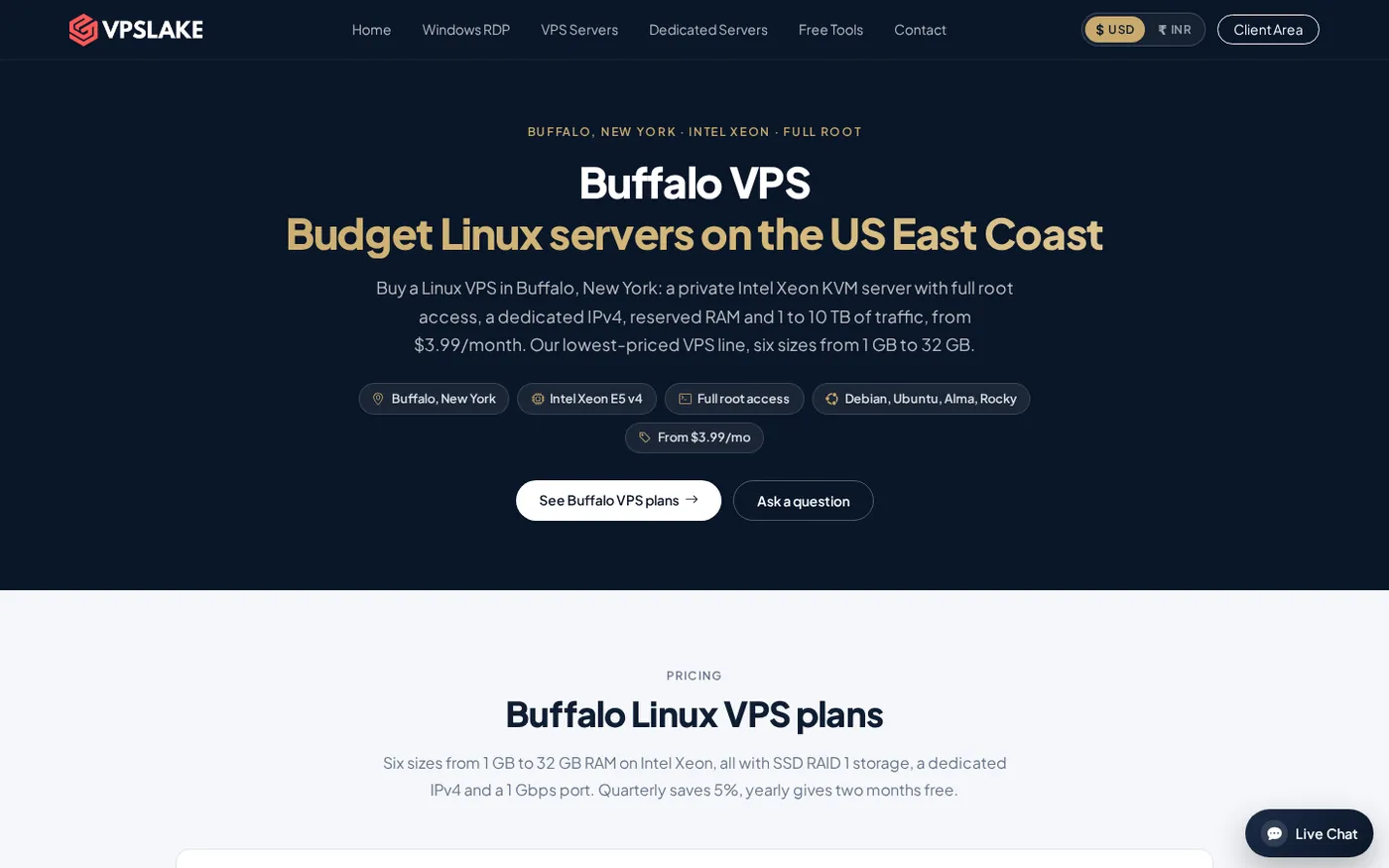
1. VPSLake Buffalo Linux VPS — best overall alternative
VPSLake is the strongest RackNerd alternative for a buyer who wants a cheap US KVM VPS without hunting for a limited-time annual deal. The Buffalo, New York line uses Intel Xeon E5-2699 v4 processors, SSD RAID 1 storage, KVM virtualization, reserved RAM, full root access, and one dedicated IPv4 address.
The 2 GB plan costs $5.99/mo and includes 2 vCPUs, 40 GB SSD storage, 2 TB of traffic, and a 200 Mbps port. It supports Debian 12, Ubuntu 24.04, AlmaLinux 9, and Rocky Linux 9. That is a sensible size for a small website, Telegram or Discord bot, n8n, a modest database, or a few lightweight containers.
For a heavier stack, the 4 GB plan is $9.99/mo with 3 vCPUs, 60 GB SSD storage, 3 TB of traffic, and a 200 Mbps port. The 8 GB plan is $16.99/mo with 4 vCPUs, 100 GB SSD storage, 5 TB of traffic, and a 300 Mbps port. These are monthly prices, so you can test a project without committing to a year. Quarterly billing saves 5%, and yearly billing gives two months free.
Payment is available by crypto, UPI, and card. Setup is automatic after payment, and the client area provides console, reinstall, reboot, and password-reset controls. If you later need a Windows desktop, VPSLake also offers Buffalo Windows RDP plans with Windows Server 2019, Windows 10 Pro, or Windows 11 Pro images; you bring your own Windows licence, with no licence surcharge.
The main reason to choose this option is clarity: you can see the price, RAM, disk, traffic, port, operating systems, and IPv4 details before ordering. It suits buyers who want UPI or crypto as well as a card route.
2. RackNerd — for annual promotion hunters
RackNerd remains a reasonable reference point if your priority is finding a low annual KVM special and selecting from several advertised datacenter locations. Its public pages describe KVM virtualization, full root access, SSD storage, an IPv4 address, instant provisioning, and a control panel with reinstall and console functions.
Choose this route when you already know the exact location and are comfortable checking the current annual offer before paying. Compare the full term, renewal conditions, traffic, CPU, and disk size; a yearly deal asks you to make the commitment upfront. For month-to-month flexibility, UPI or crypto checkout, or clearly presented reserved RAM, VPSLake is the more direct fit.
3. Hostinger VPS — for a guided dashboard
Hostinger’s VPS range is aimed at people who want KVM virtualization, root access, NVMe storage, global locations, backups, firewall management, and a web-based management experience. Its current offer is structured around longer prepaid terms, with a higher renewal rate shown after the initial period.
This can suit a new developer who values a guided dashboard and packaged tools. Before ordering, check the total due, renewal price, location, and which backup and management features are included. VPSLake is a better match for a smaller starting plan, Buffalo, direct monthly billing, or UPI and crypto; you also get a private KVM VM and reserved RAM rather than a shared RDP login.
4. DigitalOcean Droplets — for cloud tooling
DigitalOcean is a familiar choice for developers who want an API-driven cloud workflow, multiple regions, predictable bundled Droplet sizes, and integrations around databases, networking, storage, and deployment. Its Basic Droplets use shared CPU and are billed by usage with a monthly cap for bundled plans.
This option is useful when your project already depends on cloud APIs, Terraform-style provisioning, or managed services. Compare vCPU type, storage, transfer, IPv4 treatment, backups, and attached services; for a simple Linux server, VPSLake keeps those core resources together in one monthly line.
5. Vultr Cloud Compute — for many region choices
Vultr Cloud Compute is a flexible cloud option with hourly billing, multiple performance tiers, custom images, snapshots, an API, and a wide selection of regions. The official product documentation describes instance deployment from an operating system image or marketplace application and access through SSH or a console.
It is useful when the exact city or a cloud API matters more than the lowest monthly cost per GB. Check IPv4 inclusion, bandwidth calculation, and regional performance. VPSLake wins for a straightforward Buffalo deployment with a dedicated IPv4, reserved RAM, full root access, and one published monthly price.
Yearly promo deals vs a steady monthly price
Annual promotions can be excellent for a stable personal project that you expect to run for the full term. They are less convenient when you are testing an app, changing regions, or learning how much memory your workload needs.
Use this simple calculation before choosing:
| Question | What to check |
|---|---|
| Amount paid today | Monthly charge or full prepaid term? |
| Renewal | Does the price change after the first term? |
| Exit cost | Can you stop without leaving unused months? |
| Upgrade path | Can you move from 2 GB to 4 GB or 8 GB? |
| Payment route | UPI, crypto, and card available in your country? |
VPSLake gives you monthly billing, with quarterly and yearly savings when you are ready to commit. That makes it easier to start with the 2 GB plan and move up only when your application needs more memory.
If you are still comparing providers, use our VPS provider checklist to review CPU, RAM, storage, support, and billing. Buyers in India can also compare the best cheap VPS providers for India.
How to choose your RackNerd alternative
Pick VPSLake if you want a Buffalo, New York Linux VPS with reserved RAM, KVM, a dedicated IPv4, full root access, and a clear monthly price. The 2 GB plan is the practical default; choose 4 GB for Docker plus a database or 8 GB for several services.
Pick RackNerd for annual specials, Hostinger for a guided dashboard, DigitalOcean for a broader cloud workflow, or Vultr when regional choice and hourly cloud billing are central.
If you are moving an existing server, record your current OS, packages, firewall rules, DNS records, application secrets, cron jobs, and data locations first. Create the new VPS, secure SSH, copy the application data, restore the database, test privately, lower the DNS TTL ahead of the cutover, and switch traffic only after the new instance passes your checks. For containerized workloads, keep the compose files and image versions with your backup; for Ubuntu-specific VM and server concepts, use the official Ubuntu Server documentation.
FAQ
What is the best RackNerd alternative in 2026?
VPSLake’s Buffalo Linux VPS is the best fit if you want a predictable monthly US KVM VPS with reserved RAM, a dedicated IPv4, and full root access. The 2 GB plan is $5.99/mo and supports common Linux distributions.
Is VPSLake cheaper than RackNerd?
The answer depends on whether you compare a monthly plan or a prepaid promotion. VPSLake publishes monthly Buffalo pricing from $3.99/mo, while RackNerd regularly advertises annual specials, so compare the full amount due, renewal terms, resources, and payment methods.
Can I pay for a RackNerd alternative with UPI or crypto?
VPSLake accepts crypto, UPI, and card payments for its Buffalo VPS plans. Payment methods vary by provider and country, so confirm the checkout options before you migrate a production workload.
Which VPSLake plan is closest to a 2 GB budget VPS?
The Buffalo Linux VPS 2 GB plan is the closest starting point. It includes 2 vCPUs, 40 GB SSD RAID 1 storage, 2 TB of traffic, a 200 Mbps port, one dedicated IPv4, KVM, full root access, and reserved RAM for $5.99/mo.
Can I run Windows on a VPSLake server?
VPSLake offers Buffalo Windows RDP plans with a Windows Server 2019, Windows 10 Pro, or Windows 11 Pro image. Windows is BYOL: you bring your own licence, and there is no licence surcharge.