

Dedicated server price in India depends on the CPU generation, RAM, storage, network allowance and datacenter location—not just the headline number. In 2026, a like-for-like comparison can make a US bare-metal server paid from India more attractive than an old local Xeon listing, while an India-hosted machine still makes sense when your users and compliance requirements are India-specific.
Dedicated server price in India: the short answer
There is no single “correct” monthly price. Entry listings may use older Xeon processors and SATA storage, while Ryzen and EPYC servers usually cost more because they offer newer CPU platforms, NVMe storage, more memory or higher network capacity.
Compare the complete specification. Current VPSLake reference points are quoted in USD per month:
| Hardware class | Typical configuration | VPSLake price reference | Good fit |
|---|---|---|---|
| Entry Ryzen | Ryzen 5 3600, 32 GB DDR4, 500 GB NVMe | $34.99/mo | First bare-metal server, one busy application or a small hypervisor |
| Mid-range Ryzen | Ryzen 7 5800X, 64 GB DDR4, 1 TB NVMe | $64.99/mo | More concurrent services, databases or a growing game community |
| High-core Ryzen | Ryzen 9 5950X, 128 GB DDR4, 2x 1 TB NVMe | $99.99/mo | Many virtual machines, builds or high-concurrency workloads |
| EPYC with ECC memory | EPYC 7443P, 128 GB DDR4 ECC, 2x 1 TB NVMe | $129.99/mo | Virtualization, memory-sensitive applications and larger databases |
The price difference buys more cores, RAM, storage, bandwidth or memory protection. Check the datacenter, availability and final billing terms before treating any monthly figure as a quote.
What you should compare by CPU class
Search results for dedicated server hosting in India often combine several hardware generations. Use the CPU class as a quick filter, then check the rest of the row.
Legacy Xeon and entry hardware
Older Xeon servers can be suitable for a low-cost website, a basic control panel or a simple development environment. They are not automatically poor value, but a low monthly price may come with less modern single-thread performance, SATA disks or a smaller network allowance.
Ryzen 5 and Ryzen 7
Ryzen is a practical middle ground for many small businesses, developers and self-hosted applications. VPSLake’s DS-1 starts at $34.99/mo with an AMD Ryzen 5 3600, 32 GB DDR4, 500 GB NVMe storage, 30 TB traffic and a 1 Gbps network.
The Ryzen 7 DS-2 is $64.99/mo with 64 GB RAM, 1 TB NVMe, 50 TB traffic and a 10 Gbps network. Choose this class when RAM, disk space or parallel workloads matter more than the lowest entry price.
Ryzen 9 and EPYC
Ryzen 9 is useful when you need many fast cores for VMs, CI builds, databases or several services on one physical machine. DS-3 is $99.99/mo with 16 cores, 128 GB RAM and two 1 TB NVMe drives.
EPYC is the step up for larger memory footprints and server-oriented workloads. VPSLake DS-4 is $129.99/mo with 24 cores, 128 GB DDR4 ECC and two 1 TB NVMe drives. ECC can help detect and correct certain memory errors, which is valuable when a database or virtualized workload must run for long periods.
For the DS-1 processor specifically, AMD lists the Ryzen 5 3600 as a 6-core, 12-thread CPU with a 3.6 GHz base clock and up to 4.2 GHz boost clock. Check AMD’s official Ryzen 5 3600 specifications before comparing a provider’s shorthand CPU description.
What drives the monthly cost?
CPU, RAM and storage
CPU core count is only one part of the price. A server with fewer but faster cores may suit a web application, while a virtualization host benefits from more cores and enough RAM for each guest.
RAM is usually the first constraint when you run several VMs, databases or containers. Storage capacity matters, but storage type matters too: NVMe is normally a better fit for build caches, databases and high-I/O applications than an old SATA disk.
Estimate RAM for the operating system and every application, leave headroom for spikes, count CPU cores for concurrent work and decide whether one large disk or two drives better suits your data layout.
Bandwidth and port speed
“30 TB” and “1 Gbps” describe different things. Traffic is the monthly data allowance; port speed is the maximum connection rate. A plan can have a large allowance but a smaller port, or a fast port with a lower allowance.
For example, DS-1 includes 30 TB on a 1 Gbps network, while DS-2 includes 50 TB on 10 Gbps. Choose according to your transfer pattern: a database server may need low-latency disk I/O more than a very large traffic allowance, while downloads or a busy game community may need both.
IPMI, DDoS protection and setup
IPMI gives you an out-of-band management path for tasks such as remote reboot, console access and operating-system work. It is especially useful when the operating system is not responding over SSH or RDP.
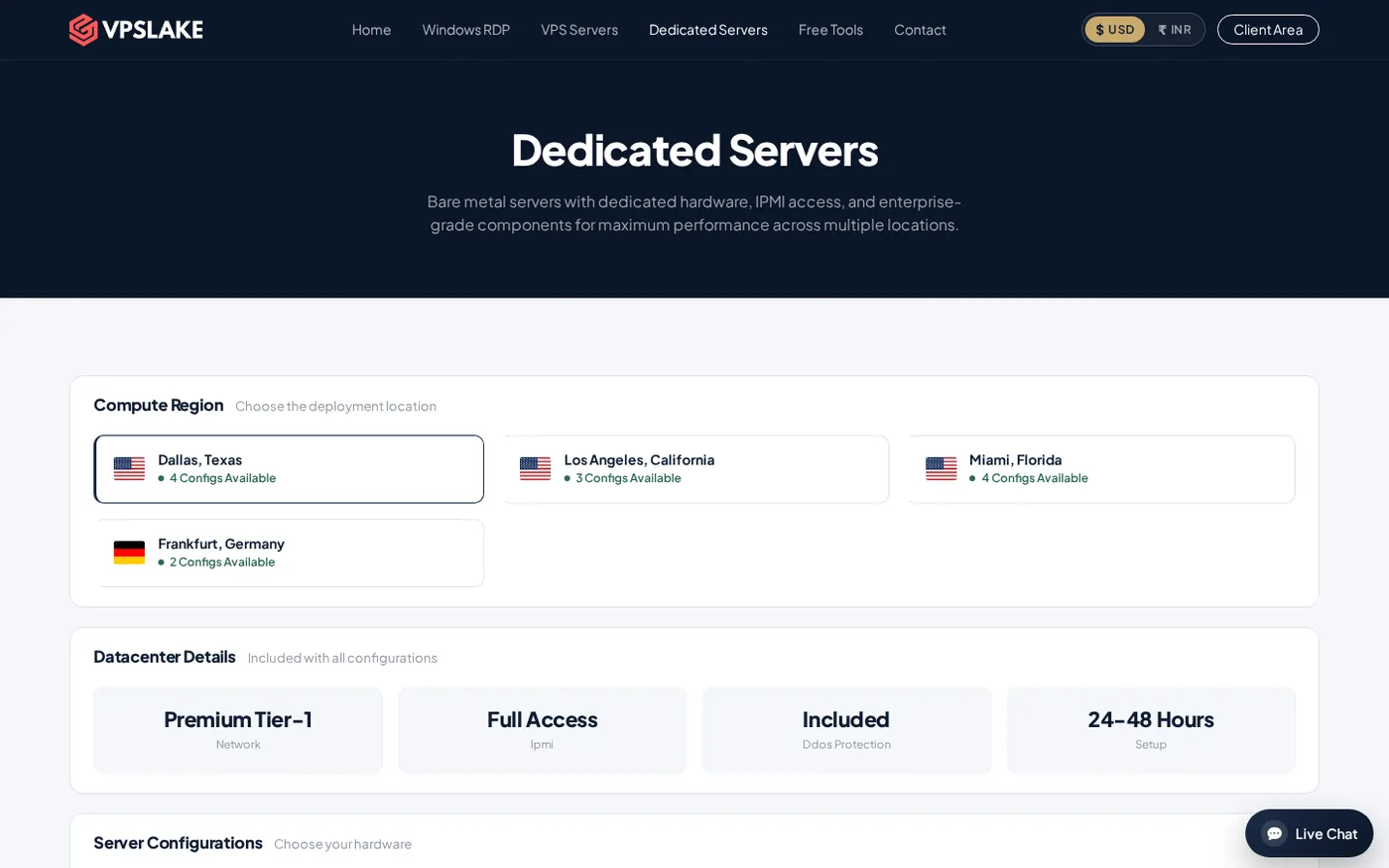
DDoS protection is another cost component. Confirm whether it is included, what network it covers and whether the provider gives you a clear escalation path. VPSLake’s dedicated configurations include IPMI access, DDoS protection, a premium Tier-1 network and a stated 24–48 hour setup window.
India-hosted vs US-hosted dedicated servers
Paying in INR does not make a server India-hosted. Location is determined by the datacenter and public IP, so verify the city before you order.
An India-hosted server is the natural choice when most users are in India, an Indian IP is required, or a project has a specific data-residency requirement. A US-hosted server can be a strong value when your audience is global, your users are in North America, or the comparable US hardware offers more CPU, storage or bandwidth at the same budget.
VPSLake’s dedicated range is offered in Dallas, Los Angeles and Miami, with Frankfurt available at a higher price for the listed configurations. The DS-1 price is $34.99/mo in its standard US locations. Confirm the city and current availability through the dedicated-server page before arranging the order.
If you are still deciding between a virtual server and bare metal, read shared hosting vs VPS vs dedicated server. For a broader India-focused look at smaller workloads, see the best cheap VPS providers for India.
Why VPSLake DS-1 is a sensible first dedicated server
The DS-1 is the clearest starting point when you want physical hardware without jumping straight to a high-core EPYC machine. At $34.99/mo, it gives you:
- AMD Ryzen 5 3600 with 6 cores and 12 threads
- 32 GB DDR4 RAM
- 500 GB NVMe storage
- 30 TB traffic on a 1 Gbps network
- Full IPMI access
- Included DDoS protection
- Premium Tier-1 network
- Setup in 24–48 hours
That combination suits a first bare-metal deployment, small hypervisor, database-backed application or self-hosted game server. Use it as a baseline when comparing local offers with less RAM, SATA storage or a smaller traffic allowance.
See the VPSLake dedicated server configurations for the current location selector and order details. Dedicated servers are ordered through WhatsApp from that page rather than through the normal VPS checkout.
Paying in INR and checking GST on the invoice
VPSLake quotes these dedicated plans in USD. The public page can display an INR conversion, but exchange rates and the final invoice can differ slightly, so treat the live payment screen as the amount to verify. Indian buyers can arrange payment through the supported UPI or card flow, then confirm the plan, location, billing period and total before authorizing payment.
Do not assume that an INR display means GST is already included or that the invoice is suitable for business input-tax records. Ask the seller what tax document is issued for your account and retain the final invoice. The Indian government’s CBIC tax-invoice guidance explains that a GST invoice records details such as the supplier, description, taxable value, tax rate and tax amount.
Checklist before you order
Use this checklist when comparing an India-hosted server with a US-hosted offer:
- Confirm the datacenter city. Make sure the IP location matches your users and application requirements.
- Record the exact CPU model. Ryzen 5, Ryzen 7, Ryzen 9 and EPYC are not interchangeable labels.
- Check reserved RAM. Note the total memory and whether it is DDR4 or ECC DDR4.
- Check disk type and layout. NVMe, SATA SSD and HDD produce different I/O results; note whether there is one drive or a pair.
- Separate traffic from port speed. Write down both the monthly allowance and the network rate.
- Ask about control access. IPMI, console access, reinstall options and reboot access reduce support dependency.
- Confirm setup time and ordering route. VPSLake dedicated servers use WhatsApp ordering and a 24–48 hour setup window.
- Review billing and tax details. Check USD/INR conversion, payment method, billing cycle, GST treatment and the final invoice.
- Plan backups separately. DDoS protection does not replace backups, snapshots or an off-server recovery copy.
The right dedicated server price in India is the lowest complete price for the hardware, location and support your workload needs. A transparent USD price is easier to evaluate than an INR headline that leaves the CPU, storage or network unclear.
FAQ
What is a good dedicated server price in India?
There is no useful single number without the hardware specification. Compare the CPU model, RAM, NVMe capacity, traffic, port speed, location, IPMI and tax treatment together; VPSLake’s current DS-1 reference price is $34.99/mo.
Is a US dedicated server cheaper than one in India?
Sometimes, but only when the hardware and included network features are comparable. A US server can offer strong value for global or North American users, while an India-hosted server may be the better fit for India-specific latency, IP or residency requirements.
Can I pay for a dedicated server from India with UPI?
Yes, where the provider supports UPI or an Indian payment gateway. Check the live INR conversion, the final invoice and the selected location before confirming the payment.
What is the difference between Ryzen and EPYC dedicated servers?
Ryzen often offers a good price-to-performance starting point for general workloads. EPYC configurations are commonly aimed at higher core counts, larger memory footprints and ECC memory; compare the specific CPU and full configuration rather than the brand name alone.
Is IPMI important on a dedicated server?
IPMI is useful because it gives you remote hardware-level access when the operating system or network service is unavailable. It can help with console access, rebooting, OS installation and basic hardware monitoring without waiting for physical access to the machine.
DONE dedicated-server-price-india words=1784