


Hetzner alternatives are worth comparing when your signup is rejected, you need a US East Coast server, or your preferred payment method is not accepted. VPSLake is the best fit for a low-cost Buffalo VPS with full root access, a dedicated IPv4 address, and crypto, UPI, or card payment options.
Why people need a Hetzner alternative
Hetzner remains attractive for self-managed Linux infrastructure, automation, and included traffic. Its cloud locations include Ashburn, Virginia and Hillsboro, Oregon, plus Germany, Finland, and Singapore; US zones are priced separately from the European network zone.
The other common reason is a rejected or delayed account. Hetzner’s fraud-prevention FAQ says details must be complete and correct, recommends avoiding a VPN, and says it may request government ID or advance payment by the customer’s own credit card.
Do not create duplicate accounts or submit somebody else’s details. If you still want Hetzner, correct your information and contact its review team. Otherwise compare location, payment method, provisioning process, and usable resources instead of only the headline price.
What to look for instead
Use this checklist before moving a workload:
- Location: Pick the region closest to your users, broker, API, or monitoring service. “US hosting” is too broad; New York, New Jersey, Virginia, Texas, and the West Coast can produce different latency.
- IPv4 policy: Confirm whether one dedicated IPv4 address is included, paid separately, or only available as an add-on.
- Resource model: Check whether RAM is reserved, whether CPU is shared or dedicated, and whether the storage is local SSD, NVMe, or network-attached.
- Traffic and port: Read both the transfer allowance and the port speed. A large traffic number does not automatically mean a fast port.
- Payment and billing: Look for the payment rail you can actually use. Crypto, UPI, and cards are not interchangeable for every buyer.
- Control: Full root access, snapshots, a console, reinstall tools, and an API matter when you manage the server yourself.
- Exit plan: Confirm that you can download backups and move the application without a proprietary panel.
The five Hetzner alternatives at a glance
| Provider | Best for | US fit | Main reason to shortlist |
|---|---|---|---|
| VPSLake Buffalo Linux VPS | Small apps, bots, Docker, and budget servers | Buffalo, New York | Low fixed monthly plans, full root, dedicated IPv4, and crypto/UPI/card payments |
| DigitalOcean | Developers who want a broad cloud product ecosystem | Multiple US deployment choices | Simple Droplet workflow plus managed databases and other cloud services |
| Vultr | Buyers who want many region and compute choices | Broad US coverage | Flexible instance types, console/API workflows, and a large location footprint |
| Akamai Cloud (Linode) | Apps that may grow into managed Kubernetes or databases | US core and distributed regions vary by service | Developer tooling with managed infrastructure options |
| OVHcloud | Public-cloud and infrastructure buyers | North American and worldwide regions | Public Cloud products with a broad infrastructure portfolio |
This is a shortlist, not a promise that every plan or service is available everywhere. Confirm the exact region, IPv4, traffic policy, and checkout total before migrating production data.
1. VPSLake Buffalo Linux VPS: best for a practical US replacement
VPSLake is the strongest choice here for a small Linux VPS on the US East Coast with flexible payments. Buffalo plans use KVM virtualization, include full root access and one dedicated IPv4 address, and offer Debian 12, Ubuntu 24.04, AlmaLinux 9, or Rocky Linux 9.
The entry plans are easy to match to a workload:
| Plan | Resources | Storage | Traffic and port | Price |
|---|---|---|---|---|
| Basic KVM 1 | 1 vCPU, 1 GB reserved RAM | 20 GB SSD RAID 1 | 1 TB, 100 Mbps | $3.99/mo |
| Basic KVM 2 | 2 vCPU, 2 GB reserved RAM | 40 GB SSD RAID 1 | 2 TB, 200 Mbps | $5.99/mo |
| Basic KVM 4 | 3 vCPU, 4 GB reserved RAM | 60 GB SSD RAID 1 | 3 TB, 200 Mbps | $9.99/mo |
| Basic KVM 8 | 4 vCPU, 8 GB reserved RAM | 100 GB SSD RAID 1 | 5 TB, 300 Mbps | $16.99/mo |
The 2 GB plan suits a Telegram or Discord bot, small website, n8n instance, or a few lightweight services. Choose 4 GB for Docker containers, a database, or a small self-hosted game server; 8 GB gives more room for several apps or a modded Minecraft server.
VPSLake accepts crypto through Cryptomus, UPI and cards through Razorpay or Cashfree, and international cards through Paddle. Setup is automatic after payment, with console access, reinstall, reboot, and password reset in the client area.
The Buffalo VPS page has the current plan comparison. These prices are for Linux; Windows is a separate BYOL product, and a Windows licence is not included.
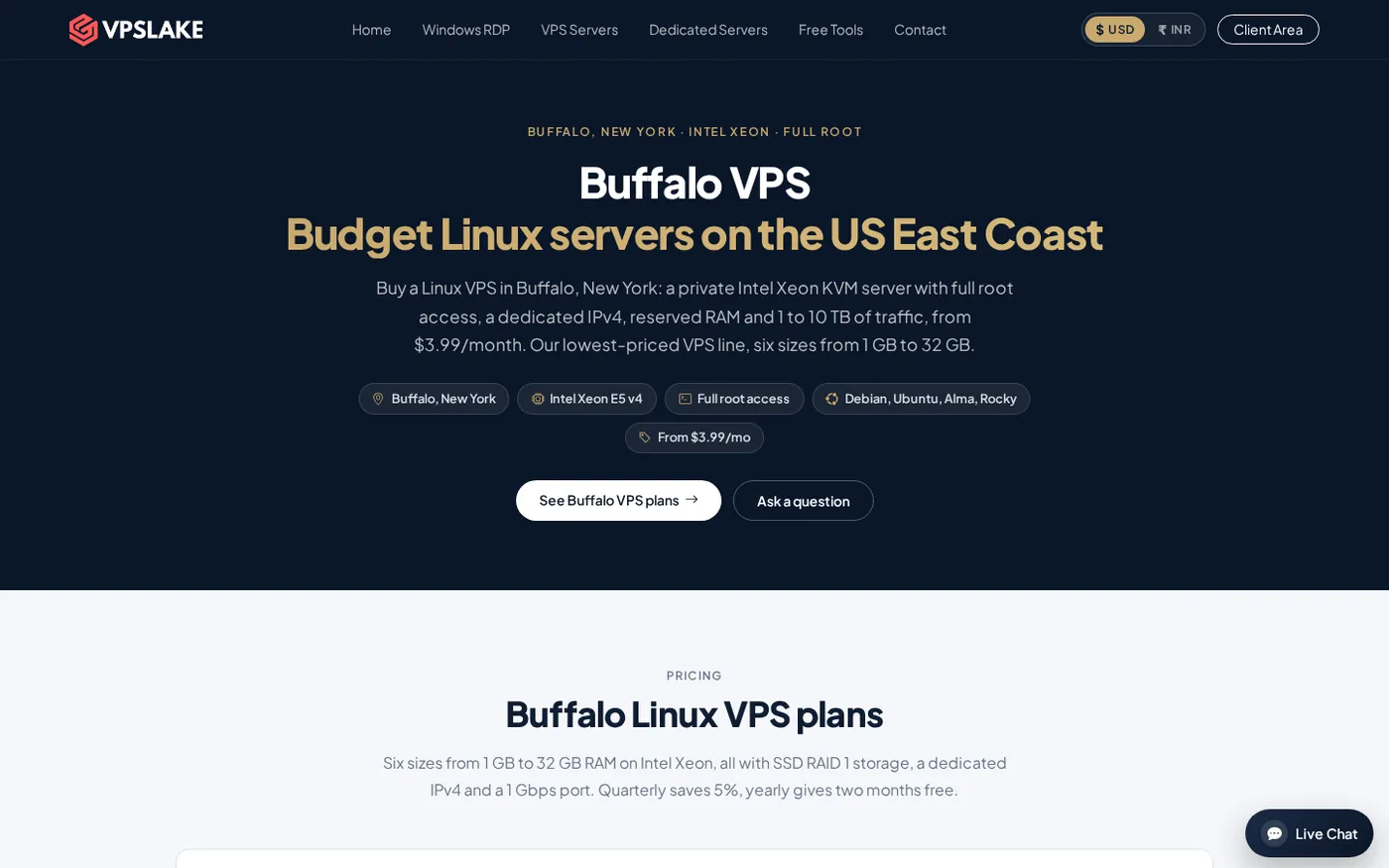
VPSLake is the right pick for a straightforward US VPS, dedicated IPv4, full root access, and payment options beyond an international credit card.
2. DigitalOcean: best for a wider managed-cloud ecosystem
DigitalOcean is a good alternative when your VPS is only one part of the stack. Its Droplets are cloud virtual machines, and the platform also offers managed databases, object storage, Kubernetes, networking, and developer tools. That can reduce the number of separate services around an application.
Its pricing page describes monthly caps and usage-based pricing, including per-second billing with a minimum charge. That suits short-lived build jobs and test machines; it is less useful when the priority is the lowest fixed price for a permanently running small VPS.
Choose DigitalOcean when documentation, managed add-ons, and a familiar developer platform matter more than maximum RAM per dollar. Check the selected US region, IPv4 allocation, backups, and data-transfer terms before comparing it with a flat monthly VPS plan.
3. Vultr: best for location and compute choice
Vultr is worth considering when region choice matters more than the cheapest European server. Its platform supports several cloud compute categories, console access, API deployment, block storage, Kubernetes, and other infrastructure services. The plan catalog can vary by region, so select the location first.
Vultr fits teams serving different US metros or testing latency before migration. Its shared and dedicated compute choices help match a bursty web service with a more consistent CPU workload.
For a small bot or personal server, include public IPv4, backups, block storage, and outbound transfer in the monthly estimate.
4. Akamai Cloud (Linode): best for managed Kubernetes and databases
Akamai Cloud, formerly Linode, suits a developer team that may grow beyond one VM. It includes compute, block and object storage, cloud firewalls, managed databases, and Linode Kubernetes Engine; managed control planes can reduce administration time.
This option makes sense when the migration is a platform decision. A team moving from one Hetzner VPS to multiple application nodes may value managed Kubernetes or databases more than a cheaper single VM.
Managed services are billed separately from compute and may vary by region. If you need one inexpensive Linux VPS with root access, compare the simple VM total with VPSLake first.
5. OVHcloud: best for a broader infrastructure portfolio
OVHcloud is another alternative when you want public cloud alongside other infrastructure products. Its Public Cloud spans Europe, North America, and Asia-Pacific, with services varying by region.
It suits a business comparing virtual machines, public-cloud services, and larger infrastructure under one account. The exact product, location, traffic policy, and IPv4 cost still determine whether it fits.
Against a budget VPS, compare reserved RAM, vCPU count, usable storage, included transfer, backups, and public IP charges.
Dedicated server options if you used Hetzner Robot
If your Hetzner workload used dedicated hardware, a VPS is not always like-for-like. Dedicated servers suit sustained CPU use, large databases, multiple VMs, or a busy game network.
VPSLake offers dedicated servers ordered through WhatsApp from its dedicated server page. DS-1 starts at $34.99/mo with a Ryzen 5 3600 and 32 GB RAM; DS-2 is $64.99/mo with a Ryzen 7 5800X and 64 GB RAM. They include IPMI and DDoS protection, with a normal 24–48-hour setup window. Confirm city and availability before ordering.
For broader comparisons, see the Contabo alternatives comparison and VPS provider checklist. If you need a Windows desktop, use the USA RDP buying guide instead of a Linux VPS.
Checklist before you switch
- Export your application, database, SSH keys, environment variables, and scheduled jobs.
- Recreate firewall rules and disable password SSH login after key access works.
- Lower DNS TTL, then test the new IP with a temporary hostname.
- Verify email, webhooks, payment callbacks, and third-party allowlists.
- Keep the old server until the new system passes a backup-and-restore test.
Switch for a concrete reason: rejected signup, required US location, payment constraint, managed services, or dedicated resources. For a small Linux service in Buffalo, VPSLake gives you a direct path to a root-access server.
FAQ
What is the best Hetzner alternative in the USA?
For a low-cost Linux VPS with a US East Coast location, VPSLake Buffalo is the best fit in this comparison. It includes full root access, KVM virtualization, one dedicated IPv4 address, and Linux images, with crypto, UPI, and card payment options.
Why was my Hetzner account rejected?
Hetzner says incomplete or incorrect registration information can delay or lead to rejection, and its fraud checks may request an ID document or prepayment by your own credit card. Avoid using a VPN during signup, do not create duplicate accounts, and contact the provider’s review team if you believe the decision is a mistake.
Is VPSLake cheaper than Hetzner?
It depends on location, plan family, traffic, IPv4 treatment, and billing terms. VPSLake’s Buffalo Linux plans start at $3.99/mo, and its 2 GB plan is $5.99/mo; compare the complete specification.
Which Hetzner alternative accepts crypto or UPI?
VPSLake accepts crypto, UPI, and cards for its Buffalo VPS plans. Payment methods and verification requirements differ by provider, so confirm the available option at checkout before beginning a migration.
Should I choose a VPS or a dedicated server?
Choose a VPS for a small website, bot, API, Docker stack, or development environment. Choose dedicated hardware when you need sustained CPU capacity, much more RAM, several virtual machines, or predictable performance for a busy workload.